To reduce or prevent impact injuries, the key is to increase the time over which the impact occurs. This way, the hand does not absorb all the impact at once. Instead, the force of the impact is spread over time, lessening the severity of the impact. In other words, you’re trying to minimize the peak force that your hand experiences. The primary way to achieve this is through deformation.
TPR Impact gloves explained
How impact-resistant materials work to prevent and reduce injuries
DEFORMATION
Deformation is achieved using impact-resistant back-of-hand materials (also known as bumpers), which are attached to the glove shell.
Ultimately, the goal of the bumpers is to optimize deformation, so the impact force is slowed as much as possible.
A simpler way to understand deformation is to imagine landing on a firm mattress versus a concrete floor from a significant distance. As you hit the mattress, it stretches when you land and bounces you a couple of times before your body finally comes to a stop. Now if you land on a concrete floor from the same height, you come to an immediate stop all at once. But in this case, you transfer an incredible amount of force into your body, sustaining more severe injury. The result in both instances is the same. You come to a stop! But, in the case of landing on a mattress, impact force is transferred much more slowly, decreasing the likelihood and severity of injury.
This is exactly how we think about manufacturing impact-resistant safety gloves.
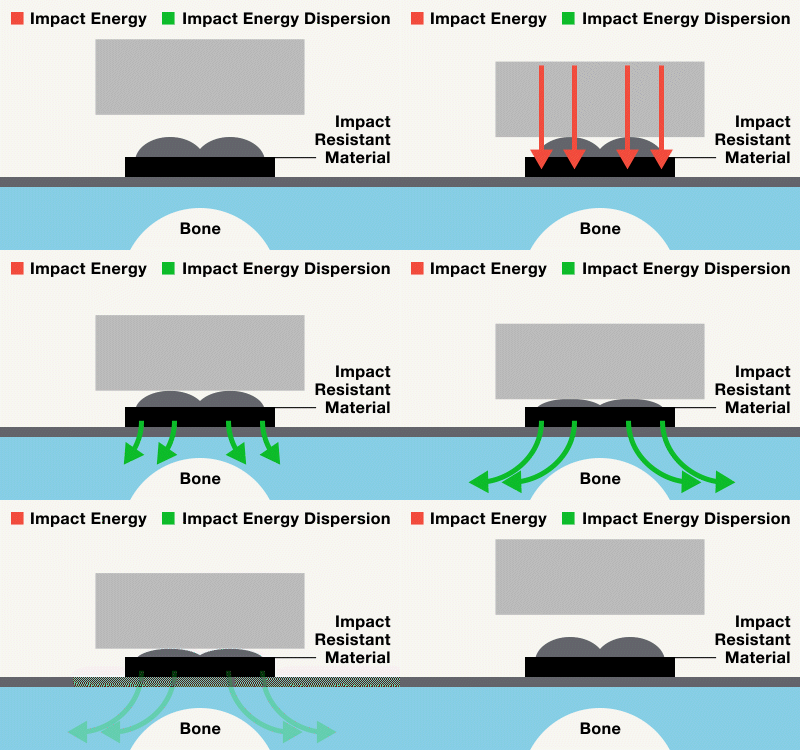
Deformation is the ability of impact-resistant material to slow the impact force transferred into the hands. It does this by deforming, or changing shape temporarily, to slow the force and lessen its impact on the hands.
North American Standard
(ANSI/ISEA 138)
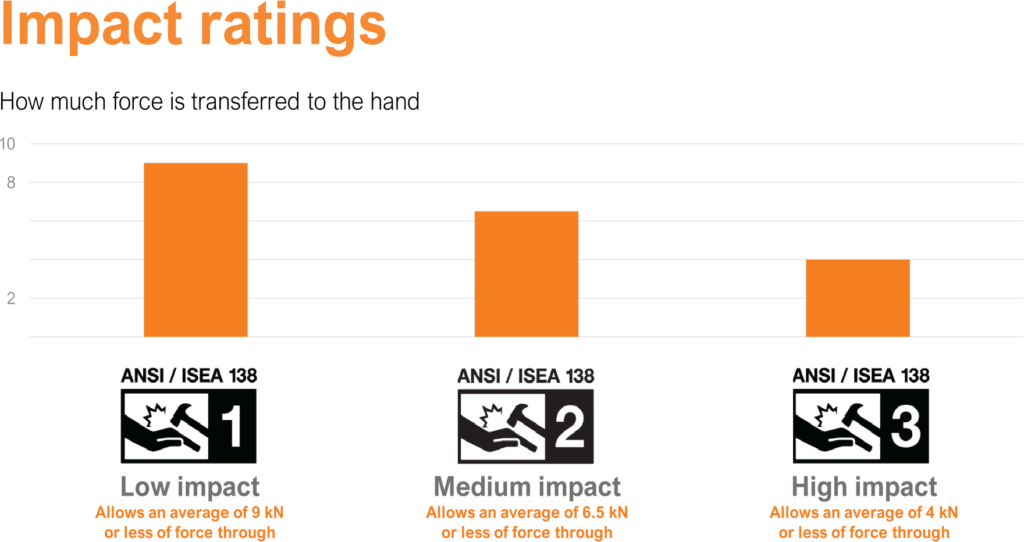
The ANSI/ISEA 138-2019 standard established the minimum performance, classification, and labeling requirements for gloves designed to protect the knuckles and fingers/thumb from impact. Three performance levels are used to classify impact resistance: level 1, 2, and 3, with level 3 offering the highest level of protection.
When looking for impact protection levels on gloves, the ANSI impact level is represented by the following icon:

Testing Method:
The palm of the impact-resistant glove is cut away, so the testing area only includes the back of the glove’s shell and the impact absorbing material. This halved glove is then placed on a metal anvil with a special force transducer underneath to record how much force goes through the glove. Next, a 2.5 kg striker is dropped on the testing location, imparting 5 joules of energy into the glove. The force transducer records the impact force. This test is repeated for each knuckle, finger, and thumb (knuckles are tested four times while fingers and thumbs are tested five times). The average of the knuckle tests is compared to the average of the fingers/thumb tests to determine the final impact testing score:
· Level 1: Allows an average of 9kN (kilonewtons) or less of force through the glove.
· Level 2: Allows an average of 6.5kN or less of force through the glove.
· Level 3: Allows an average of 4kN or less of force through the glove.